
BFSI and Capital Market
CA. Swati Panchal, CA. Dharesh Mody, CA. Rajesh Ameta
From Scale to Scrutiny: The New Compliance Architecture of India’s NBFCs
An Industry That Outgrew Its Rulebook
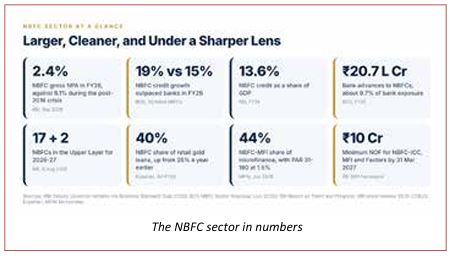
On a single day in August 2026, the Reserve Bank of India did two things that, read together, tell the entire story of the Indian NBFC sector. It placed four state-owned infrastructure financiers, REC, PFC, IRFC and HUDCO, in the Upper Layer, conceding that they are now systemically consequential. And it proposed to confine NBFCs to term loans, striking at the flexi-credit products that made consumer finance leaders such as Bajaj Finance formidable. By 31 March 2027, less than eight months later, the minimum Net Owned Fund for several NBFC categories rises to ₹10 crore, a threshold many small regional lenders are struggling to meet.
The common thread is unmistakable. Regulation is no longer calibrated to what an NBFC calls itself, but to how large it is, how it is funded and how its products behave. For Chartered Accountants who audit, advise and sit on the boards of these entities, the compliance conversation has moved from the filing calendar to the business model itself.
Twenty Years: From the Periphery to the Plumbing
Two decades ago, NBFCs were regarded as specialists at the margins: truck financiers in the hinterland, gold lenders in Kerala, hire-purchase houses for two-wheelers. The RBI introduced the category of systemically important non-deposit NBFCs only in 2006. Today, NBFC credit stands at about 13.6% of GDP and nearly a quarter of scheduled commercial bank credit. The sector has been through a full cycle of exuberance, contagion and repair.
|
Dimension |
Mid-2000s |
Post-2018 crisis |
2026 |
|
Regulatory lens |
Deposit-taking focus; ND-SI category created in 2006 |
IL&FS and DHFL expose liquidity and governance gaps |
Four-layer Scale-Based Regulation; 19 entities in the Upper Layer |
|
Entry capital (NOF) |
₹2 crore |
₹2 crore |
₹5 crore; ₹10 crore by March 2027 for key categories |
|
Asset quality |
Limited disclosure |
GNPA peaks around 6.1% |
GNPA at 2.4% (FY26) |
|
Funding |
Public deposits and bank lines |
Heavy reliance on short-term CPs |
Banks fund about 45% of incremental needs |
|
Product frontier |
Vehicles, gold, hire purchase |
Housing, wholesale real estate |
Digital, flexi credit, co-lending, MSME and gold |
The lesson of 2018 shaped everything that followed. When IL&FS defaulted, the market discovered that an NBFC could be adequately capitalised on paper yet fatally mismatched in liquidity. Scale-Based Regulation, effective October 2022, was the RBI’s structural answer: proportionate oversight, so that the largest lenders face bank-like discipline while the smallest are spared needless burden.
The Three Developments, Decoded
1. The flexi-loan draft: product design becomes a compliance question
The draft amendment to the Credit Facilities Directions, released on 6 August 2026, states that an NBFC shall offer only credit products in the nature of term loans, with a fixed repayment schedule and no restoration of a repaid limit. Revolving credit is reserved for RBI-authorised credit card issuers, and the separate framework for demand and call loans is proposed to be repealed. The supervisory intent is clear: to prevent evergreening, where an account looks current only because the borrower repays one drawdown with another.
The commercial stakes are large. Brokerages estimate flexi products at roughly 14 to 15% of Bajaj Finance’s AUM, with Tata Capital in the high single digits; the industry has argued that products worth over ₹2 lakh crore could be affected. Bajaj Finance’s stock fell nearly 6% the day after the draft, and the company has reportedly begun launching term-loan variants from November 2026. Industry bodies, including the Finance Industry Development Council, have sought carve-outs for supply chain and working capital limits. Final directions are awaited, and as drafted they carry no explicit transition window.
2. The Upper Layer: the cost of being consequential
The 2026-27 list identifies 17 NBFCs on revised criteria using March 2026 financials, alongside PNB Housing Finance and Sammaan Capital, which remain under the five-year rule. Membership brings bank-grade obligations: a Common Equity Tier 1 ratio of at least 9%, a large exposure framework, enhanced governance and disclosure, and mandatory listing within three years of identification. That mandate is why Tata Capital and HDB Financial Services came to the market in 2025, and why Tata Sons, a core investment company, remains in the list while its deregistration question is examined. For the four government financiers, which already list their equity, the real shift lies in exposure limits and capital composition rather than in disclosure.
3. The NOF glide path: consolidation by capital
The 2021 framework raised the minimum NOF from ₹2 crore to ₹5 crore by March 2025 and ₹10 crore by March 2027 for investment and credit companies, with a parallel path for NBFC-MFIs and Factors. The Federation of Indian Asset Financiers Associations (FIAFA), representing small non-deposit asset financiers, challenged the glide path; the Madras High Court upheld the RBI’s authority and directed it to consider the representation. Failure to comply can lead to cancellation of the Certificate of Registration. For a regional vehicle or tractor financier with a ₹40 crore book, raising another ₹5 crore of tier-one equity is not a formality. The likely outcomes are promoter infusion, mergers, conversion into business correspondents or co-lending partners, or exit.
The RBI has balanced this with relief at the other end. From April 2026, Type I NBFCs with assets below ₹1,000 crore that use no public funds and have no customer interface may seek exemption from registration, a welcome rationalisation for family investment vehicles.

Segment by Segment: Where NBFCs Matter Most
|
Segment |
NBFC footprint |
Compliance watchpoint |
|---|---|---|
|
Farmer and rural |
Agriculture is under 2% of NBFC credit directly, but tractor, rural vehicle and microfinance loans reach the farm household |
Agri GNPA near 6%; small rural lenders most exposed to the NOF rise |
|
MSME |
About 11.7% of MSME credit from banks and NBFCs; strong in micro-LAP |
Cash-flow underwriting; supply chain limits may need restructuring if revolving facilities are barred |
|
Personal and consumer |
Bajaj Finance, Tata Capital and fintech partners dominate digital consumer credit |
Flexi-loan draft; Digital Lending Directions 2025; key fact statements |
|
Gold |
NBFC share of retail gold loans rose to 40%; gold advances grew 53% in FY26 |
Graded LTV caps, valuation, auction and collateral-return norms |
|
Microfinance |
NBFC-MFIs now hold 44% of the market |
PAR down to 1.5%, but borrower indebtedness caps and NOF of ₹10 crore apply |
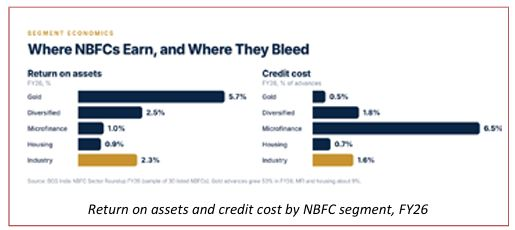
The gold loan story deserves attention. Gold loans against jewellery at banks more than doubled in the year to May 2026, and NBFC gold specialists earned a return on assets of 5.7% with credit costs of just 0.5%. Yet the RBI’s Financial Stability Report has cautioned that a prolonged fall in gold prices could lift delinquencies, which is why valuation integrity and auction discipline now attract supervisory focus at Muthoot, Manappuram and IIFL Finance alike.
Challenges Beneath the Headlines
-
Funding concentration. Bank advances to NBFCs have reached ₹20.7 lakh crore, and banks met about 45% of incremental funding in FY26. Any tightening of bank risk weights transmits instantly to NBFC borrowing costs.
-
Margin compression. Sector NIM eased from 6.7% to 6.4% in FY26 and ROA fell 31 basis points, even as credit costs stayed at 1.6%.
-
Unsecured and microfinance cycles. MFI credit costs of 6.5% in FY26 are a reminder that recovery after a stress cycle is expensive.
-
Compliance fixed costs. Board committees, independent directors, risk and compliance heads, IT and cyber controls, and CIMS returns impose costs that fall disproportionately on smaller entities.
Advice for Boards, CFOs and Auditors
1. Audit the product, not just the ledger. Map every live facility against the draft term-loan definition and identify accounts that remain current only through redrawal.
2. Plan capital before the deadline. Entities below ₹10 crore of NOF should finalise their route, whether infusion, merger, co-lending partnership or orderly exit, well before March 2027, with board-approved timelines.
3. Stress-test liquidity like a bank. Structural liquidity statements, the liquidity coverage ratio for larger NBFCs, and contingency funding plans should be tested against a shock to bank lines.
4. Strengthen gold collateral controls. Independent valuation, purity testing, vault audit, auction documentation and timely release of pledged gold now carry direct regulatory exposure.
5. Formalise co-lending and digital partnerships. Retention ratios, loss-sharing, pricing and data flows with banks and lending service providers should be contractually clear and auditable.
6. Prepare early for the Upper Layer. Middle-layer NBFCs approaching the threshold should build listing readiness, CET1 planning and governance structures before identification, not after.
The Major Crux
|
In one line The Indian NBFC is no longer a lightly supervised alternative to a bank; it is a core artery of credit to consumers, MSMEs, rural India and gold-backed households, and it is now regulated accordingly. The flexi-loan draft tests product integrity, the Upper Layer tests governance at scale, and the ₹10 crore NOF tests capital commitment. NBFCs that treat compliance as strategy rather than paperwork will turn this tighter regime into a lasting advantage, and Chartered Accountants are best placed to guide that transition. |
RBI’s Liquidity Paradox: When Record NRI Inflows Meet Monetary Tightening
Introduction
Monetary policy is often viewed through a single indicator: the repo rate. Yet India’s recent experience demonstrates that the quantity of liquidity circulating through banks can be just as important as the price of money. During 2026, a special Reserve Bank of India (RBI) foreign-exchange swap facility attracted exceptional foreign-currency inflows, strengthening the external funding position while injecting substantial rupee liquidity into the banking system. The resulting liquidity surplus added a further dimension to RBI’s efforts to maintain effective monetary-policy transmission. By October 2026, the challenge had reversed. After absorbing excess funds, RBI was again supplying short-term liquidity to prevent overnight rates from overshooting its policy benchmark.
The Origin: A Special Window for Overseas Funds
The starting point was RBI’s June 2026 special US dollar–rupee swap facility for banks mobilising eligible Foreign Currency Non-Resident (Bank), or FCNR(B), deposits. Eligible deposits generally carried maturities of three to five years. Similar arrangements also covered specified overseas foreign-currency borrowings and external commercial borrowings. The objective was to attract foreign exchange during a period of pressure on the rupee.
NRIs placed deposits with authorised banks; banks then exchanged foreign currency for rupees through RBI’s swap arrangement, with an obligation to reverse the exchange at maturity. The distinction is fundamental because it explains both the immediate rupee-liquidity effect and the future foreign-currency obligation.
The response was unusually large. Official reporting put total inflows through the special swap facilities above US$143.5 billion by 18 September 2026, including approximately US$132.98 billion attributable to FCNR(B) deposits. The FCNR(B) window closed on 31 August, while the specified borrowing windows were reported as remaining available until 31 December 2026.
How Foreign Exchange Became Domestic Liquidity
When a bank swaps dollars with RBI, it receives rupees that can support domestic funding and settlement. Across many banks, the combined effect can create a large liquidity surplus. Thus, an intervention intended primarily to attract foreign currency can alter conditions in the domestic money market.
Reported banking-system surplus liquidity climbed from roughly ₹3.5 lakh crore in August to more than ₹11 lakh crore in September. This had an immediate pricing consequence. With abundant funds available, banks had less incentive to borrow overnight, and the weighted-average call rate—the operational target of monetary policy—fell to around 4.93% in mid-September, below the then-prevailing repo rate. The gap showed why a policy-rate announcement alone could not guarantee the desired degree of monetary restraint.
The inflows also affected banks’ funding strategies. RBI’s October Bulletin, as reported in financial-sector coverage, associated the FCNR(B) mobilisation with lower fresh deposit rates and reduced reliance on certificates of deposit. Surplus liquidity may therefore temporarily ease bank funding costs even when the wider policy direction is towards tighter financial conditions.
The Repo Rate and the Liquidity Paradox
On 7 October 2026, RBI raised the policy repo rate by 25 basis points to 5.50% against a backdrop of renewed inflation pressures. But a repo-rate increase is not, by itself, a mechanical withdrawal of cash from banks. It changes the policy benchmark and the price at which monetary conditions are intended to operate. Liquidity absorption requires separate instruments and transactions.
This distinction is the essence of the paradox. If excess liquidity persists in the banking system despite a higher repo rate, the transmission of monetary tightening may remain incomplete. RBI must therefore manage both the policy rate and the quantity of readily available funds. Its objective is not simply to make liquidity scarce, but to keep short-term rates appropriately aligned with the chosen monetary stance.
RBI’s Toolkit: From Absorption to Fine-Tuning
RBI used variable-rate reverse repo (VRRR) auctions to absorb surplus funds temporarily. It also employed foreign-exchange sell–buy swaps and government-security sales, which withdraw rupees from the system through different channels. Another measure tightened the daily maintenance requirement for banks’ cash reserves: the minimum daily holding was increased from 90% to 99% of the prescribed requirement, while the underlying cash reserve ratio itself remained unchanged at 3%. This reduced banks’ flexibility to run down balances on individual days; it was not a conventional increase in the CRR percentage.
These measures helped bring surplus liquidity down sharply. However, liquidity management is inherently dynamic. Tax outflows, government transactions, demand for currency during festivals and RBI’s foreign-exchange intervention can all affect banking balances. By 22 October 2026, reports indicated that the surplus had narrowed to almost zero, while overnight market rates had moved above the 5.50% repo rate. RBI consequently conducted variable-rate repo (VRR) auctions to inject funds temporarily.
There is no contradiction in RBI absorbing liquidity in September 2026 and injecting it in October 2026. The same operating framework may require action in opposite directions as conditions change. VRRR drains funds; VRR supplies them. Both can serve the common objective of orderly money markets and effective policy transmission.
Implications for Banks and Borrowers
For banks, these developments illustrate the difference between plentiful aggregate liquidity and stable, predictable funding. An extraordinary inflow may reduce short-term funding costs, but banks must still manage deposit maturities, interest-rate risk, foreign-exchange exposures and the eventual unwinding of swap positions. The composition and duration of funding matter as much as its immediate volume.
For borrowers, the impact is more complex than a simple assumption that abundant liquidity means cheaper loans. Lending rates respond to policy benchmarks, funding costs, credit risk and competition, often with different lags. Excess liquidity may support credit availability, while higher policy rates and tighter overnight conditions may exert upward pressure on borrowing costs. Businesses therefore need to assess both rate sensitivity and refinancing risk.
The experience is also relevant to treasury oversight, asset–liability management and financial reporting. Large temporary inflows can affect interest margins, liquidity buffers and investment decisions. Boards, auditors and finance professionals should distinguish sustainable changes in funding conditions from short-lived effects of central-bank operations.
Managing Liquidity as Forex Swaps Mature
The swap mechanism creates a further issue that deserves attention. The dollars received through the facility are not necessarily a permanent addition to freely usable foreign-exchange resources. The underlying swaps reverse on their contractual maturity dates, requiring careful planning for future dollar delivery and rupee flows. This does not imply an immediate crisis; it means headline reserve movements must be understood alongside forward commitments and maturity profiles.
These developments also demonstrate the interconnectedness of external stability and domestic monetary management. A measure designed to attract foreign exchange can increase domestic liquidity, while subsequent liquidity-absorption operations may influence money-market rates and bond yields. Further intervention in the foreign-exchange market can also alter rupee liquidity, illustrating the close relationship between external-sector management and domestic monetary conditions.
Conclusion
India’s liquidity developments in 2026 highlight the complexities of central banking and monetary-policy management. Substantial NRI-related foreign-currency inflows initially generated surplus rupee liquidity in the banking system, even as inflationary pressures warranted tighter monetary conditions. RBI responded through liquidity-absorption measures alongside an increase in the policy repo rate. However, within weeks, evolving cash flows and changing market conditions necessitated selective liquidity injections to maintain orderly money-market conditions.
India’s recent liquidity experience illustrates that effective monetary policy extends beyond adjustments to the policy interest rate. It requires continuous calibration of banking-system liquidity, effective transmission of monetary-policy decisions to market rates, and careful consideration of the longer-term implications of extraordinary funding arrangements. For financial institutions and finance professionals, these developments highlight the importance of looking beyond headline foreign-exchange reserves and policy repo rates to understand the financial flows and liquidity dynamics influencing India’s monetary environment.