
UNDERSTANDING SUSTAINABILITY REPORTING & BRSR IN INDIA

Name: Vaidehi Axay Patel
Registration No.: WRO0816068
City: Vadodara, Gujarat
Introduction
The corporate world is undergoing a transformation — profit is no longer the sole measure of success. Environmental stewardship, social responsibility, and ethical governance have emerged as equally important pillars for evaluating business performance. Stakeholders today expect organizations to disclose not only their financial results but also their impact on the planet, employees, and communities.
In India, this expectation has taken a structured form through the Business Responsibility and Sustainability Report (BRSR), introduced by the Securities and Exchange Board of India (SEBI). From FY 2022–23, BRSR has become mandatory for the top 1,000 listed companies by market capitalization, aligning Indian corporate disclosures with international ESG standards.
Evolution of Sustainability Reporting in India
- The Foundation: NVGs and BRR
In 2011, the Ministry of Corporate Affairs (MCA) issued the National Voluntary Guidelines (NVGs) on Social, Environmental, and Economic Responsibilities of Business. These became the basis for SEBI’s Business Responsibility Report (BRR), made mandatory for the top 500 listed companies from FY 2012–13.
- Need for Advancement:
While BRR was a step forward, it was largely qualitative and lacked harmonization with international ESG frameworks, limiting its comparability and investor relevance.
- Transition to BRSR:
In 2021, SEBI introduced the Business Responsibility and Sustainability Report — a more comprehensive, data-driven, and globally aligned ESG disclosure format. The BRSR is based on the National Guidelines on Responsible Business Conduct (NGRBC) and is designed to align with frameworks such as the Global Reporting Initiative (GRI), Task Force on Climate-related Financial Disclosures (TCFD), and Sustainability Accounting Standards Board (SASB).
What is BRSR? – A Detailed Overview
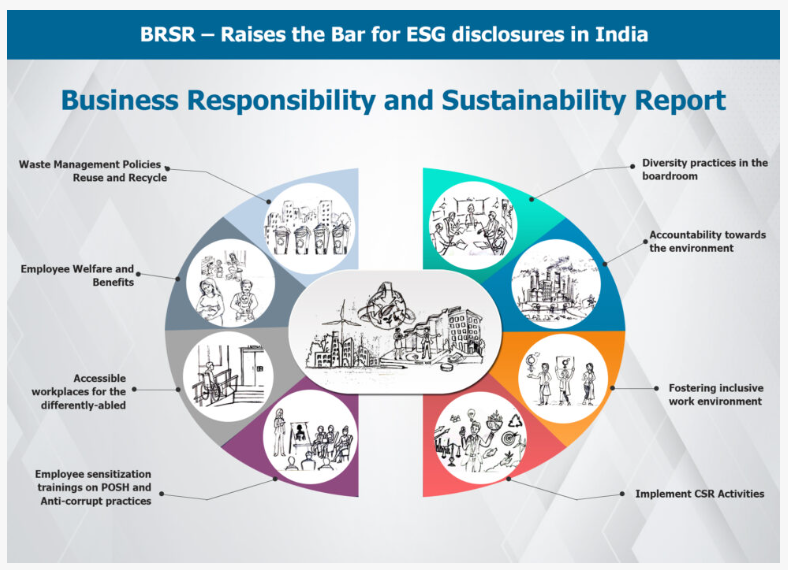
The Business Responsibility and Sustainability Report (BRSR) is SEBI’s standardized ESG disclosure format, designed to provide investors, regulators, and the public with a quantitative and qualitative view of a company’s environmental, social, and governance performance.
It is based on the National Guidelines on Responsible Business Conduct (NGRBC) and structured in three main parts:

- Section A – General Disclosures
- Section B – Management & Process Disclosures
- Section C – Principle-wise Performance Disclosures
Covers company profile, listing details, products/services, employee strength, operations, and value chain partners.
Details governance mechanisms, policies, and the management approach for each NGRBC principle.
This is the core of BRSR and contains two types of indicators:
- Essential Indicators
- Mandatory for all reporting companies.
- Provide baseline ESG data that is necessary for stakeholder assessment.
- Cover quantifiable, comparable metrics directly linked to the 9 principles of NGRBC
- Leadership Indicators
- Voluntary, but encouraged for advanced ESG maturity.
- Go beyond compliance, showing innovation, best practices, and leadership in sustainability.
- Demonstrate how the company is integrating ESG considerations into strategic decision-making.
BRSR not only measures compliance but also reflects how deeply sustainability is embedded in a company’s DNA. It sets a clear baseline through Essential Indicators and rewards innovation through Leadership Indicators, creating a two-tier system that balances mandatory reporting with aspirational excellence.
The 9 Principles of NGRBC:
- Ethics, Transparency, and Accountability
- Sustainable Products and Services
- Employee Well-being
- Stakeholder Engagement
- Human Rights Protection
- Environmental Protection and Resource Efficiency
- Responsible Public Policy Advocacy
- Inclusive Growth and Equitable Development
- Customer Value and Fairness
Benefits of BRSR
- Enhanced Transparency – Strengthens corporate credibility by openly sharing ESG performance, building long-term trust with investors, customers, regulators, and communities.
- Global Alignment – Brings Indian companies in sync with leading global sustainability frameworks, enabling easier benchmarking and attracting international capital.
- Informed Decision-Making – Equips leadership with accurate, data-driven ESG insights to guide strategic planning and operational improvements.
- Investor Attraction – Appeals to ESG-focused domestic and global investors who prioritize responsible and sustainable businesses.
- Risk Mitigation – Enables early identification and management of environmental, social, and governance risks, protecting business continuity.
- Long-Term Value Creation – Positions the company as a sustainability leader, enhancing brand reputation, competitive advantage, and stakeholder loyalty.
Challenges in Implementation
- Data Collection – Aggregating reliable ESG data from operations and supply chains can be resource-intensive.
- Knowledge Gap – Limited expertise in ESG reporting within some organizations.
- Dynamic Standards – Need to keep up with changing global sustainability disclosure frameworks.
The Road Ahead
India’s sustainability reporting is moving toward deeper integration with corporate strategy. Emerging trends include:
Technology-Driven Reporting - Use of AI, blockchain, and real-time ESG dashboards to improve accuracy, accessibility, and timeliness of sustainability data.
Wider Mandates - Potential inclusion of smaller listed companies and eventually unlisted large enterprises, expanding ESG accountability across the business ecosystem.
Integrated Reporting - Combining financial and ESG disclosures into a single, cohesive report for holistic transparency, enabling stakeholders to assess both profitability and sustainability performance simultaneously.
Conclusion
The BRSR is more than a compliance requirement — it is a framework for responsible growth and long-term value creation. By adopting it proactively, Indian companies can demonstrate resilience, attract sustainable investments, enhance stakeholder trust, and position themselves as leaders in the global sustainability movement. Those who embrace BRSR as an opportunity, rather than an obligation, will not only shape the future of sustainable business in India but also strengthen their competitiveness in an increasingly ESG-conscious global marketplace.