
VALUATION VS HYPE: ARE IPO VALUATIONS TRULY RATIONAL?

Name: Dinesh Kamath
Registration No.: WRO0764348
City: Mumbai, Maharashtra
VALUATION VS HYPE: ARE IPO VALUATIONS TRULY RATIONAL?
“Unicorns are getting haircuts!”
The above phrase highlights startups which are valued over one billion dollars which see their valuation shrink when they go public. It’s not only the American markets that have seen this phase- Be it ‘Paytm’ or be it ‘Delhivery’, Indian markets have witnessed such phenomenon too!
"IPOs often grab headlines with soaring valuations and market hype—but do they truly reflect a company's intrinsic value? This presentation explores the gap between market excitement and actual business worth."
Understanding the difference between Private Equity Valuations & Public Equity Valuations:
Before going public, Private Investors have infused cash in the company betting they have potential to corner the markets. They have become an accepted yardstick for what these companies are worth for on the public market. But many believe they are all hyped up figures! Let us understand why-
Valuation multiples undergo significant compression as companies transition from private to public markets, a phenomenon rooted in fundamental differences between pre-IPO and post-IPO market dynamics. This shift reflects the interplay of liquidity premiums, risk recalibration, and institutional investor behavior that reshapes pricing frameworks during public listings.
Methodological Divergence in Valuation Approaches
Venture capital valuations employ aggressive forward revenue multiples based on projected market dominance. Public markets anchor valuations to trailing twelve-month financials and sector-specific multiples, creating inherent multiple compression.
Pre-IPO valuations suffer from opacity discounts (estimated 20-40% variance) due to limited financial disclosures and unproven governance structures. The regulator-mandated prospectus disclosure and subsequent quarterly reporting reduce information asymmetry, enabling precise benchmarking against public comparable.
The capital with which the private investors deal with is beyond our capability. While the primary objective of PE funds is to achieve substantial returns via value creation and profitable exit, retail investors on the other hand look forward to building personal wealth or to generating side income.
Hype in 2021 vs Normalization in 2025:
Post-COVID, retail participation in Indian markets surged, with many aspiring to become the next Rakesh Jhunjhunwala. Unfortunately, this enthusiasm often lacked fundamental
understanding, making retail investors vulnerable to pump-and-dump schemes.
In 2021, IPOs and startup valuations in India reached record highs, fueled by global liquidity, low interest rates, and aggressive risk-taking. Valuations leaned heavily on growth projections and market sentiment, sidelining profitability and fundamentals, resulting in inflated IPO prices and a surge in unicorns.
Between 2022 and 2024, the 'funding winter' set in—driven by rising interest rates, tightened global liquidity, and a broader economic slowdown.
By 2025, IPO valuations have become more rational. Investors now emphasize sustainable growth, clear paths to profitability, and strong governance. Market sentiment has shifted from hype to fundamentals, with valuations better reflecting a company’s true worth.
Latest trend in Increase in OFS in Mainboard IPO’s rather than Primary Infusion of Capital
To simplify the above topic, let me ask y’all: “Why does a company go public?” The answer is twofold: to fund operations or to offer an exit for early investors. According to Edelweiss' IPO Fund Update, in FY25, around 40% of capital raised came from fresh issues (used for growth, debt repayment, and capex), while 60% came from offers for sale (OFS), enabling existing shareholders to exit or reduce their stake.
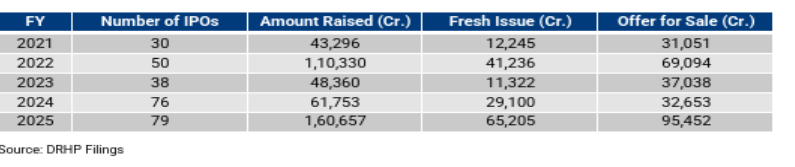
Now comes the next question- how is it affecting Private/Public Equity Valuations?
A high Offer for Sale (OFS) component in an IPO suggests that existing shareholders are exiting rather than raising fresh capital for growth. This lack of capital inflow, coupled with perceived insider uncertainty, can lead investors to assign more conservative valuations. Even strong financials may not reflect the company's true potential when proceeds aren't reinvested into the business.
How does Grey Market Premium work & affect IPO Valuations?
The Grey Market Premium (GMP) is the unofficial difference between IPO issue price and grey market trading price. Though unregulated and based on trust, many use it to estimate listing gains, However, GMP figures can be inaccurate, manipulated, and don’t guarantee listing performance, which depends on fundamentals and market trends. Since they are unofficial
figures, retail investors get easily trapped by the valuations.
Did Indian IPOs from 2024 -2025 accurately reflect a company’s true intrinsic value? -
ET Intelligence Group’s analysis of 101 mainboard companies that raised money through initial public offers (IPOs) since January 2024 shows that majority of the sample companies have not been able to improve upon their listing gains. In the sample, almost three out of every five companies traded below their listing prices as on May’2025.

Also, even though it seems to be encouraging that 57% companies continue to trade above their initial offer prices, just half of them have been able to earn 10% or more returns, reflecting that the remaining companies have either earned meagre returns or could not generate any. No doubt, some multi-baggers such as the recent LG’s IPO do show up occasionally in the markets,
they always do not truly depict the real story of the IPO Saga!
Do Oversubscribed IPO’s guarantee optimistic valuations?
History repeats itself! There are dozens of IPO’s/FPO’s which have been oversubscribed in the past but are now trading below their listed prices!
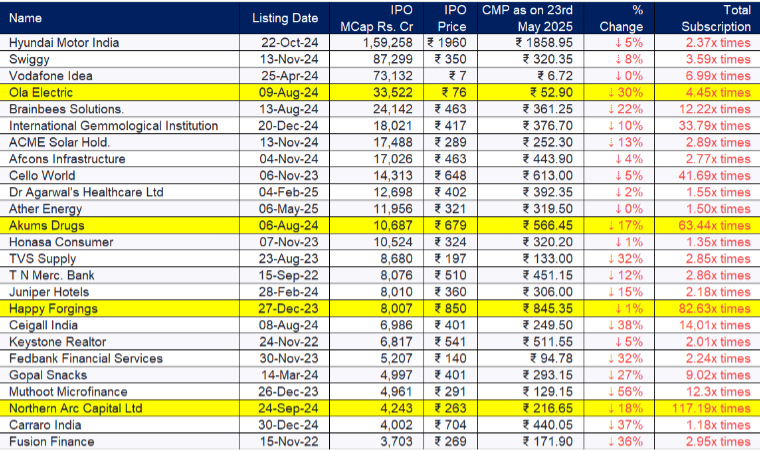
With this, we understand that-
Subscription ≠ Success: High demand doesn’t ensure strong post-listing returns; weak demand often signals poor performance.
Size & Sector Impact: Smaller issues and less favorable sectors see weaker returns.
Then, what’s the correct way to method an IPO as per Analysts?
Analysts employ rigorous methodologies to cut through IPO hype, combining
Comparable company analysis (industry multiples),
Precedent transaction evaluations (historical M&A benchmarks) to establish fair valuations.
Marco Economic Factors: Example: During the 2024 elections, market overvaluation led to sharp corrections of up to 40% in many portfolios. In such uncertain conditions, some IPOs are unable to attract positive investor sentiment despite strong fundamentals & some companies often postpone IPOs, as weak sentiment can severely affect valuations.
Conclusion:
Valuation isn’t a fixed formula—it’s part math, part mindset.. Hype may get a company listed, but only fundamentals keep it afloat. While IPOs are great for raising capital and grabbing headlines, they’re just the opening act—not the final verdict—on a company’s true worth.